


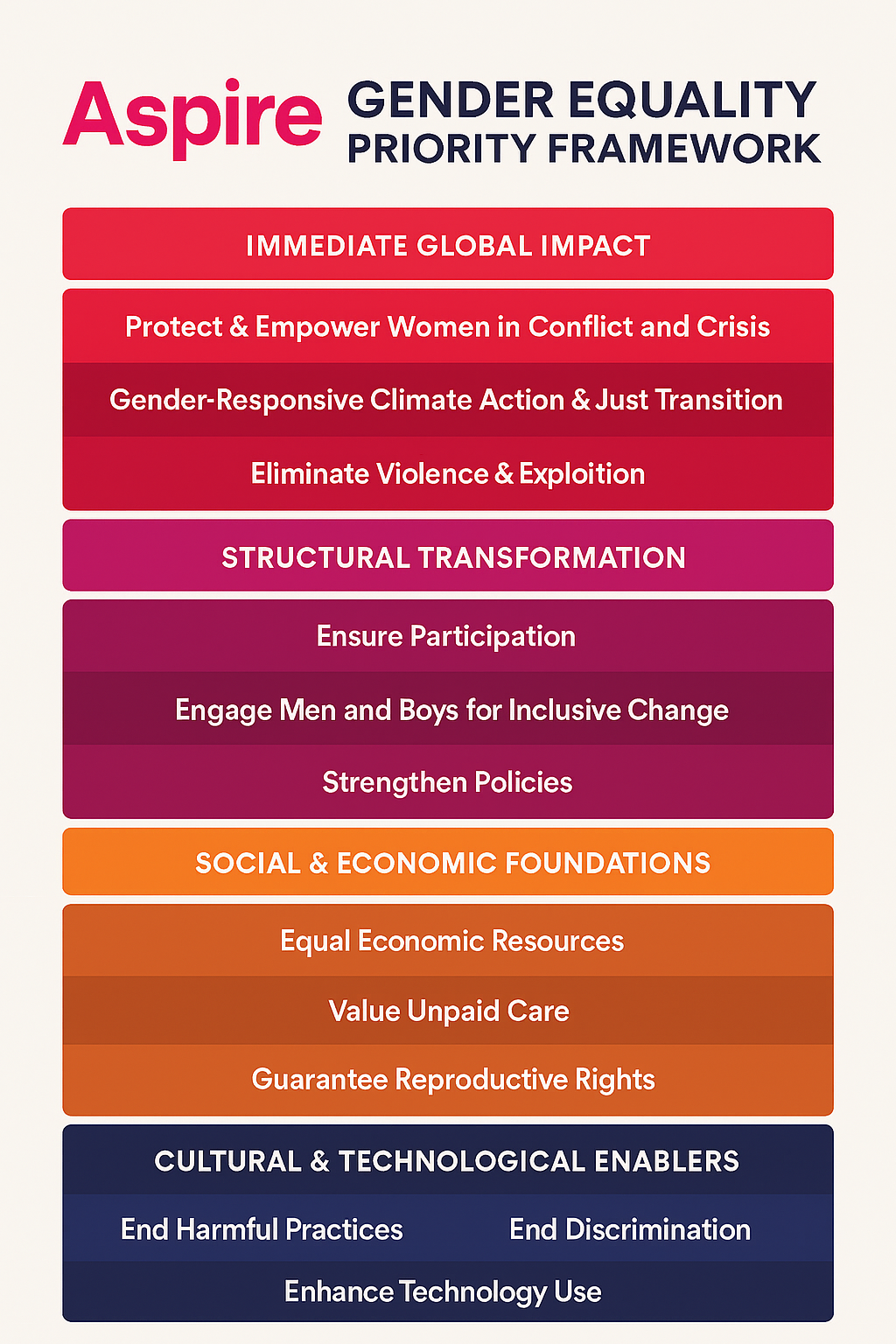
Aspire Gender Equality Priority Framework
Gender equality is the state in which every person regardless of gender identity or expression has equal rights, responsibilities, and opportunities to thrive in all areas of life.
True gender equality recognises the diversity of human experience and ensures that policies, practices, and cultures enable authentic participation, shared power, and equitable access to resources and decision-making.
It moves beyond binary notions of gender to embrace men, women, and gender diverse individuals, fostering environments where everyone can contribute fully and flourish without fear.
At its core, gender equality is a human centred principle: it is about dignity, fairness, and belonging for all because equality is not a zero-sum game, but a collective gain for societies, economies, and humanity.
Why This Framework?
This framework is rooted in UN Sustainable Goal 5 for gender equality and its original nine sub areas, which remain globally recognised benchmarks for gender equality. However, we have adjusted and recreated it for three reasons
- Current World Issues: The original targets were designed in 2015. Today’s landscape needs to also include urgent crises, armed conflict, climate change, and rising polarisation and demands additional focus areas.
- Business Relevance: We’ve translated global policy language into strategic priority initiatives that businesses and organisations can own, making them actionable for leadership contexts. We believe that business aspires to be more purpose driven and contribute positively to global social issues.
- Inclusive Approach: We added a further new pillar on engaging men and boys to counter divisive narratives (e.g., manosphere thinking), foster collaboration rather than opposition .
Hierarchy of Importance for Fastest Global Impact
Top Tier – Immediate Global Impact
- Protect & Empower Women in Conflict and Crisis Safeguard women in war zones and humanitarian crises; ensure participation in peacebuilding. Why now: Conflicts and displacement are surging, and women face extreme sexual violence and exclusion during war.
- Gender‑Responsive Climate Action & Just Transition Embed gender equality in climate policy, finance, and disaster risk reduction. Why now: Climate change amplifies inequality and risk, and urgent integration accelerates resilience.
- Eliminate Violence & Exploitation End all forms of violence, trafficking, and exploitation against women. Why now: Violence against women and trafficking are rising globally, especially in fragile states and online spaces.
Second Tier – Structural Transformation
- Ensure Leadership Participation Guarantee equality of leadership in decision‑making across sectors. Why now: Representation drives systemic change and inclusive governance.
- Engage Men and Boys for Inclusive Change Involve men to dismantle harmful stereotypes and reduce divisiveness. Why now: Many men support gender equality and are looking for a purposeful role to play. For boys and young men, countering polarisation and extremist narratives about women is critical for sustainable equality.
- Strengthen Policies & Laws Adopt and enforce gender responsive laws and corporate governance frameworks. Why now: Accountability underpins all progress.
Third Tier – Social & Economic Foundations
- Equal Economic Resources Secure equal access to property, finance, and entrepreneurship opportunities. Why now: Economic inequality is widening globally, and without equal access to property, finance, and entrepreneurship, women risk being locked out of recovery and innovation in a rapidly changing economy.
- Value Unpaid Care Recognise and redistribute unpaid care through flexible work and support systems. Why now: Unpaid care work surged during the pandemic and continues to underpin economies without recognition. Redistributing this burden is critical to prevent burnout and enable full workforce participation.
- Guarantee Reproductive Rights Ensure universal access to sexual and reproductive health and rights. Why now: Reproductive rights are under threat in many regions with women being prosecuted for abortions or even miscarriages. Lack of access to healthcare directly impacts education, employment, and gender equality. Immediate action safeguards autonomy and wellbeing.
Fourth Tier – Cultural & Technological Enablers
- End Harmful Practices Eliminate child marriage, FGM, and other harmful traditions. Why now: Harmful traditions like child marriage and FGM persist despite global commitments. Accelerating elimination is vital to protect millions of women from lifelong health, education and social consequences.
- End Discrimination Remove systemic bias in law, policy, and workplace culture. Why now: Systemic bias continues to block progress in law, policy, and workplaces. Tackling discrimination now ensures inclusive growth and prevents regression on hard-won rights.
- Enhance Technology Use Close the digital gender gap and leverage tech for empowerment. Why now: The digital gender gap is widening as technology advances. Closing this gap today is essential to ensure women are not excluded from AI driven content, economies and future opportunities.
How This Drives Change Fast
- Top tier tackles existential threats such as war, climate, violence where intervention saves lives and stabilises societies.
- Second tier creates systemic levers for inclusion and governance.
- Third tier builds economic and social resilience.
- Fourth tier sustains cultural and technological progress.
This framework reframes equality as for everyone women, men, boys and people of diverse gender identities. Without that universal framing, efforts risk deepening division instead of building collective progress.
